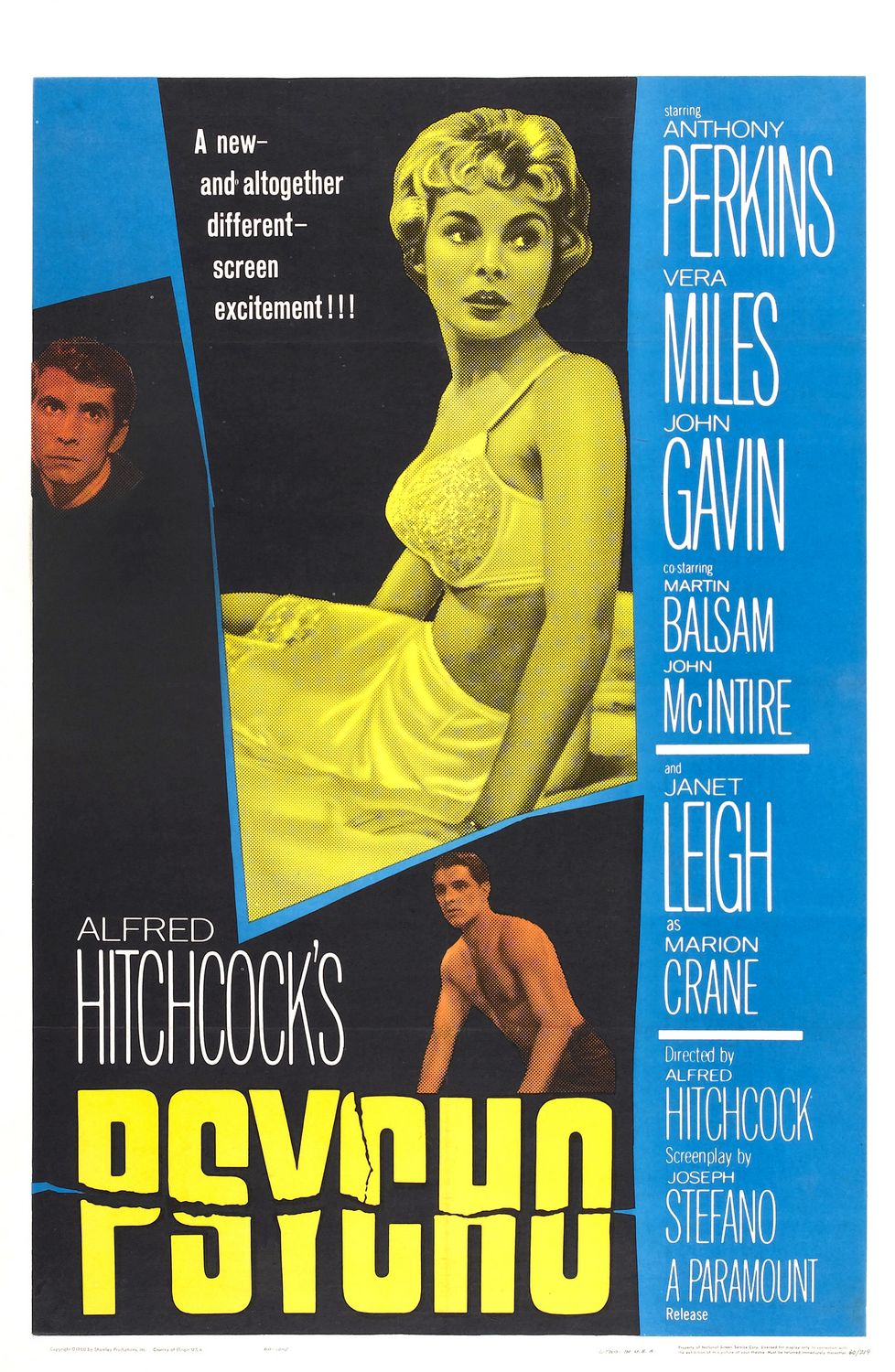
Psycho by Alfred Hitchcock
 |
| Fig 1 Movie Poster |
Psycho is the right word to use for this film, even if it only applies to the mother of Norman Bates, owner of the motel, and Norman himself. The film is based on the 1959 novel of the same name by Robert Bloch and is lightly based on the crimes of Wisconsin murderer and grave robber, Ed Gein. It tells the story of Marion Crane, a secretary, who steals money from her employer to try and run away to be with her lover. She stayed at Bate's motel where she meets Norman, who is revealed to be the psycho killer who is mentally disturbed. However the film starts to seem unclear as to its direction to begin with, as Carr says in his review, ''
The brilliance begins with the story, which was adapted upon and improved over Robert Bloch's original novel. It's very simple story that still holds up today with some more twisted realities of people's psychoses.'' (Carr, S.D.).
It seems that Psycho is a manipulative film, Hitchcock made it so that each part is purposely pieced together rather marvelously. Hitchcock cleverly creates a suspense that when in place creates a otherwise inviting and free of harm scenario. As Gibron mentions, ''
the director laid the fear right at you own front door - in the most private and vulnerable of places within said home.'' (Gibron, 2010). When we first encounter Mr. Bates, he seems to be a kind, gentle and concerning man, but with a seemingly innocent, 'mothered', look and feel about him. Instantly making him seem odd and out of place. Then later we discover this to be true. When it is revealed that he suffers from the lose of his father, the death of his mother by his own hand and his psychological break and change. When Marion comes to stay he has a chance to revisit the depths of his insanity when he has a argument with 'mother' because he is physically attracted to Marion. Any sexual thought or desire seems to trigger the 'mother' and that then triggers a murder.
This concept is very interesting, and the first instance we see is when Marion takes a shower, the most iconic and recognized scene of this movie. Kermode mentions in his review that ''
Dispute still rages as to the provenance and power of Psycho's notorious shower sequence, which has become perhaps the most iconic murder scene in the history of Cinema.'' (Kermode, 2010). This scene is mostly called this because of the modern way in which it was made, even today over 50 years in the future, it still feels very modern. Being murdered in the shower, (See fig 2)
 |
| Fig 2: Shower scene |
with not that much in the way of detail, seemed to have worked in Hitchcock's favor. The scene is comprised of a montage of shots that imply that Marion is being stabbed. However in a more realistic approach, a stab wound would produce much more blood than that, therefore a multitude of stab wounds would fill the bath with blood, and be even more visible in the water. So does this mean that it's not as modern? No, we have to consider that this film was created in a time that special effects were in their baby stages. So for what it is, this scene is iconic in the fact that it was effective - even without the gory detail.
This being said, having killed off Marion, the story changes, as the viewers are lead to believe that she is the main protagonist. But it seems now the attention is given to Norman. This put him in the spot light right when he needs to be. As Vasquez Jr mentions in his review, ''
There are many Freudian themes present within Bates, who has a bit of an Oedipus complex and longing for his mother he aches to stay loyal to, but doesn't dare leave her side.'' (Vasquez Jr, 2013). As the character is shown, you can see as the film progresses, there are subtle hints of mothering that come from Norman that seem like he is being to over caring.
 |
| Fig 3 Norman's ''mothering'' side. |
As shown in figure 3, Norman has brought Marion supper, showing a mother's care, only to later on show a more teenager/childish persona by spying on her as she removes her clothes. The caring he shows is a symbol of him being close to his mother, causing that effect to rub of on him. But then later we see that Norman is still holding onto the past when Marion's sister enters the house to find a room filled with old toys. This could symbolizes Bate's need to be attended too, like a child, wanting to remain loyal and with his mother.
In conclusion, Pyscho is a predictable subtle horror. With barely any incline that it is actually so. With Norman having his mental condition and in her own way as does Marion with her obsession to be with Sam. There is not no doubt that this is one of those ''It does what it says on the tin'' type of films. A brilliant film indeed, and you got to love that creepy smile. (See figure 4).
 |
| Fig. 4 Norman Bate's Creepy Smile |
Bibliography.
Carr, K (S.D). http://www.7mpictures.com/psycho-50th-anniversary-edition-blu-ray-review/ (Accessed on 27/01/15)
Gibron, B (2010) http://www.popmatters.com/post/132282-psycho-and-the-scene-that-changed-modern-horror-forever/ (Accessed on 27/01/15)
Kermide, M (2010) http://www.theguardian.com/film/2010/oct/22/psycho-horror-hitchcock (Accessed on 27/01/15)
Vasque Jr. F (2013) http://cinema-crazed.com/blog/2013/10/23/psycho-1960/ (Accessed on 27/01/15)
Illustration List:
Fig 1: Film Poster (1960)http://www.impawards.com/1960/posters/psycho_xlg.jpg (Accessed on 27/01/15)
Fig 2: Shower Scene. (1960) http://www.blastr.com/sites/blastr/files/styles/media_gallery_image/public/images/psycho-shower-scene.jpg
Fig 3: Norman's ''mothering'' side. (1960) https://cinephilefix.files.wordpress.com/2010/06/psycho_image3.jpg (Accessed on 27/1/15)
Fig 4: Norman Bate's Creepy smile.(1960) http://www.thebuzzmedia.com/wp-content/uploads/2013/10/The-Pros-to-Being-a-Psychopath-176019901.jpg (Accessed on 27/1/15).